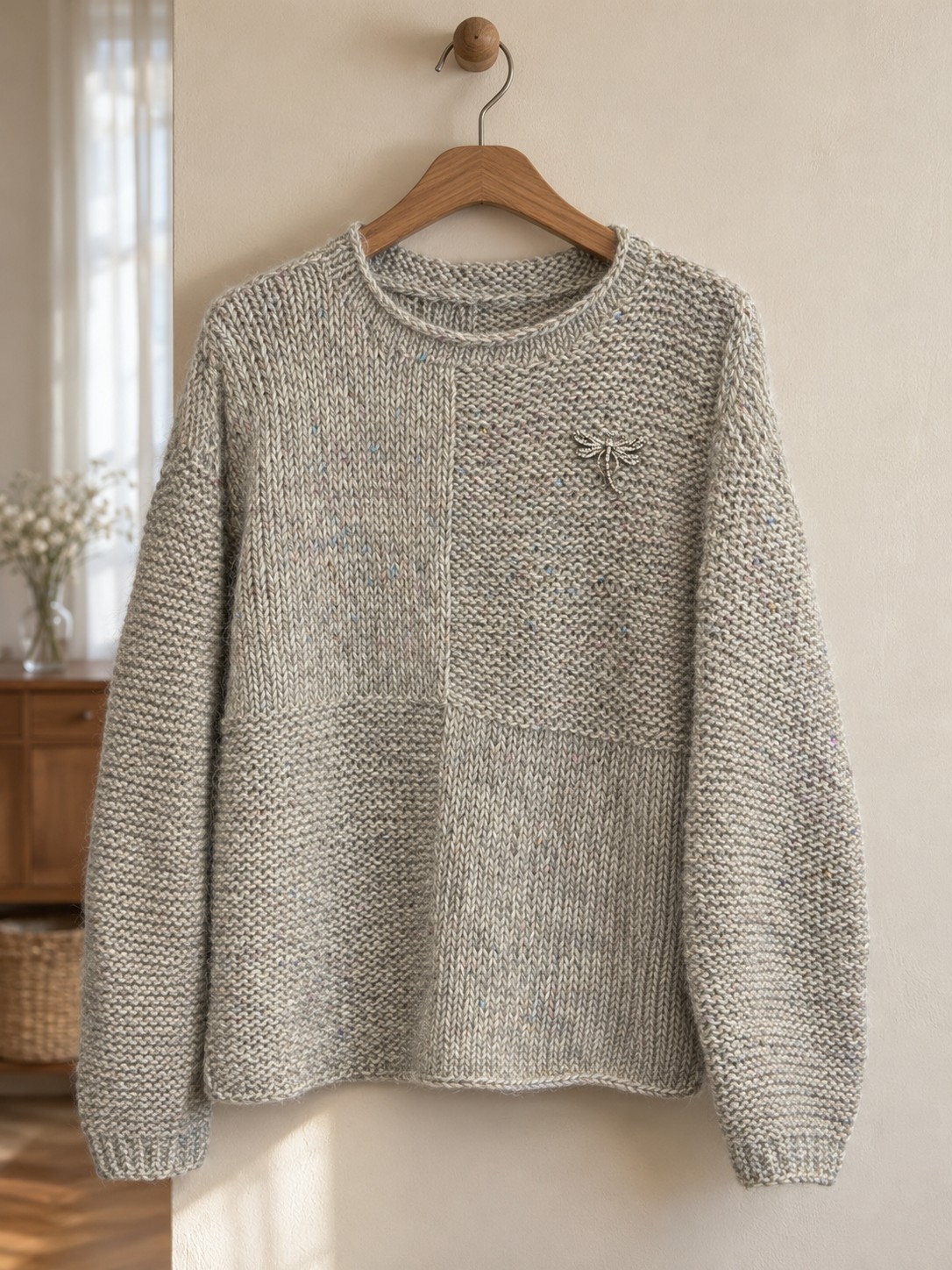
What you need
| Sizes | XS, S, M, L, XL and 2XL — to fit chest 28 to 41 inches, finished chest 33 1/4 to 46 3/4 inches with about 5 inches of ease. Boxy and straight, with no shaping anywhere below the underarm. The sweater photographed is size S. |
|---|---|
| Yarn | Chunky wool with a tweedy fleck, about 120 yd / 110 m per 100 g ball, in a pale stone grey. 477 to 880 yards — 4 to 8 balls depending on size, counted stitch by stitch from the pattern with 8% added for swatching and finishing. One yarn throughout: all the pattern comes from turning the fabric over. |
| Needles & notions | US 11 / 8 mm circular (32 in) for the body and double-pointed needles for the sleeves, with US 10 / 6 mm for the cuffs and collar — one size down keeps the rib and the roll firm. Four markers for the quarters, two holders and a blunt tapestry needle. |
| Gauge (tension) | 12 sts and 16 rows = 4 inches on US 11 / 8 mm, blocked — in both stockinette and reverse stockinette, which is the same fabric seen from the other side. That matching gauge is the whole reason the blocks lie flat, so the pattern has you swatch both and look along the join. |
Skills you’ll use
- Knit and purl — the entire fabric is just these two, in blocks
- Working in the round with markers dividing the quarters
- Dividing at the underarm and working front and back flat
- Picking up stitches round a straight armhole for the sleeves
- Simple paired decreases down each sleeve
- A 1x1 rib cuff and a rolled stockinette collar
- Two shoulder joins — the only seams in the sweater
What’s in the PDF
- 15-page PDF, fully graded for six sizes, XS to 2XL
- Finished measurements for every size, plus every stitch and row count
- A diagram of the four quarters opened out flat, with the block line marked
- A note on why the blocks lie flat, and how to swatch both fabrics
- Row-by-row instructions: body, front and back, both sleeves, cuffs and collar
- A measured schematic, with the reasoning behind every proportion
- Finishing, blocking and a troubleshooting table
Questions about this pattern
Is this really beginner-friendly? It looks complicated.
It looks far cleverer than it is. There is no chart and no colourwork — the chequerboard is nothing but knit stitches and purl stitches in big blocks. In the round, a whole round is just knit one quarter, purl one quarter, repeated; above the line you do the same thing the other way about. If you can knit, purl and count to your quarter width, you can knit this sweater.
Why do my blocks need the same gauge in both fabrics?
Because stockinette and reverse stockinette sit side by side everywhere in this sweater, and the line between them only looks crisp when both fabrics are the same size. For many knitters purl rows come out a little tighter than knit rows, so the pattern has you work one swatch that is half of each, and look along the join before casting on — a two-minute check that saves the whole project.
Why is there no ribbing at the hem?
The hem needs no band at all: the stockinette blocks want to curl one way and the reverse-stockinette blocks the other, and because no two neighbouring blocks match, they hold each other flat. The collar is the same trick in miniature — a narrow stockinette band left to roll on purpose.