What you need
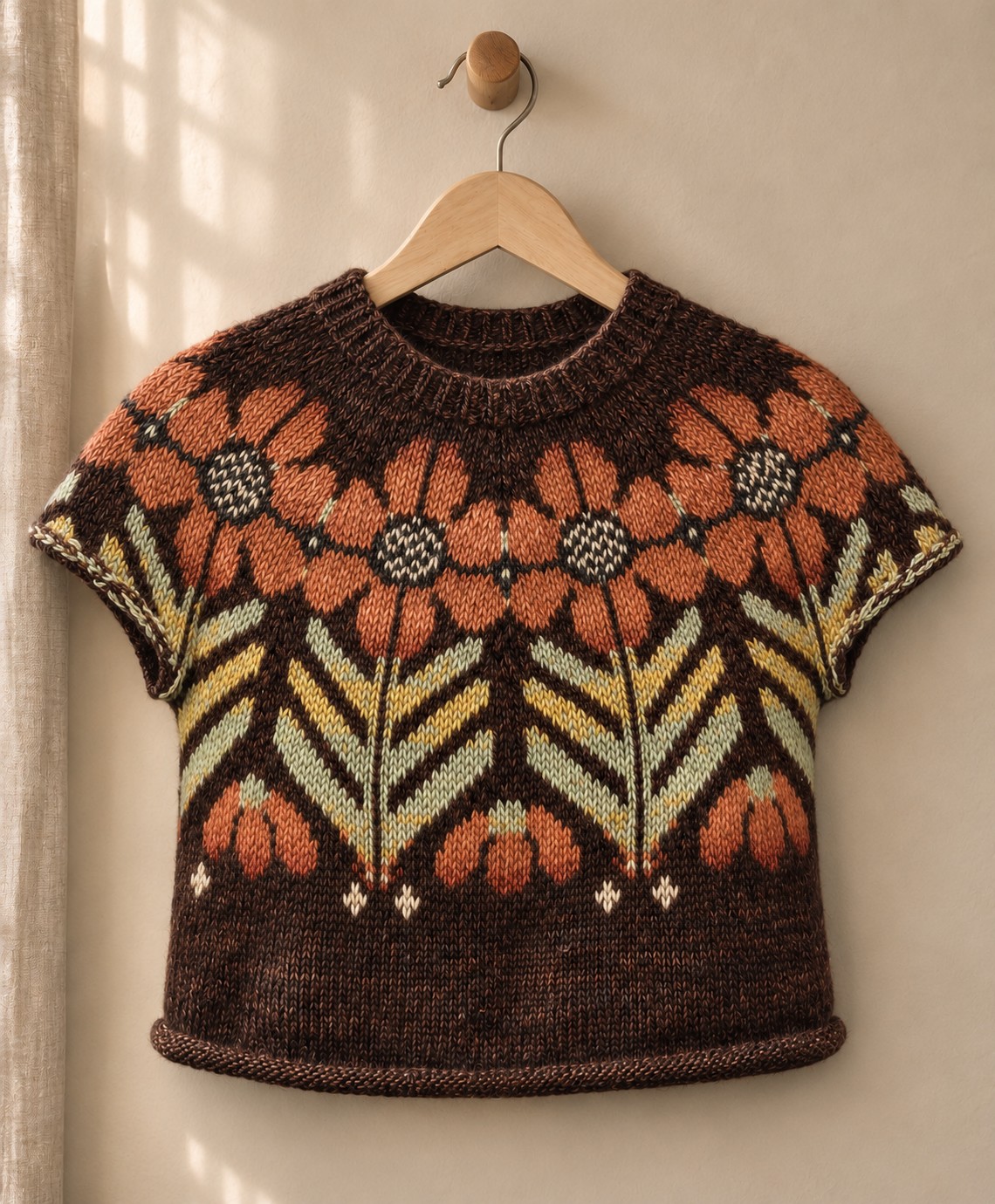
| Sizes | XS, S, M, L, XL and 2XL — finished chest 31 to 57 inches with 4 to 6 inches of ease; total lengths 20 1/4 to 25 inches. Pick the size whose finished chest is three to six inches larger than your own: this is a tee, and it is meant to skim. The sample photographed is size S on a 31 in bust. |
|---|---|
| Yarn | Worsted weight wool in five colours — a marled brown ground (Rustwood) and four solids: Terracotta, Sage, Ochre and Bone. 570 to 1067 yards in all depending on size: three to five 100 g balls of the main colour, and one 50 g ball of each contrast is enough at every size. Yardage is given per colour, per size, with a little over 8% spare. |
| Needles & notions | A US 8 (5 mm) circular, 16 in and 32 in, for the body, yoke and sleeves, and a US 6 (4 mm) circular, 16 in, for the neckband only. Stitch markers, two stitch holders or spare circulars for the sleeve stitches, and a tapestry needle for the duplicate-stitch dots and the ends. |
| Gauge (tension) | 18 stitches and 22 rows = 4 in / 10 cm in stranded stockinette, worked in the round on US 8 (5 mm), measured after blocking. Work your swatch in the round and in two colours — stranded fabric is firmer than plain, and a flat swatch will lie to you. |
Skills you’ll use
- Knitting in the round, top down, with no seams anywhere
- Stranded colourwork with only ever two colours in hand — all 74 chart rounds verified
- Reading a full-colour chart, printed top down, with its colour schedule
- Simple yoke increases — two plain increase rounds widen the motif from ten stitches to twenty
- Dividing for the sleeves: holders at chart round 52, a few stitches cast on under each arm
- A ribbed neckband, a rolled stockinette hem and short cap sleeves from the held stitches
- Duplicate stitch to finish — eight cream specks in each flower centre
What’s in the PDF
- 15-page PDF, fully illustrated and graded for six sizes, XS to 2XL
- Photographs of the front and the back
- A full-colour 74-round chart, printed top down, with its colour schedule
- Schematic and construction diagrams, with every measurement graded
- Every stitch count written out for each size, plus yardage per colour, per size
- Row-by-row instructions: neckband, yoke, divide, body, rolled hem, sleeves and finishing
- The designer's own check: 1357 verified calculations, listed in the PDF
Questions about this pattern
How hard is the colourwork, really?
If you can knit in the round and carry two colours, you can knit this. Five yarns appear in the yoke, but the chart was built to a rule and tested round by round: every one of its 74 rounds carries at most two colours. The flower centres are worked in the ground colour and their cream specks are added afterwards in duplicate stitch, and the stems take the colour of whichever leaf chevron they pass through — so you never hold a third strand anywhere.
Why do the tulips sit below the underarm?
Because the chart doesn't stop at the divide. At chart round 52 the sleeve stitches go onto holders, a few stitches are cast on under each arm, and the same chart simply carries on down the body — so the row of tulips lands below the arm, exactly as in the photographs.
Is there any shaping to keep track of?
Very little. Every round is knit — there is not a purl stitch above the neckband — and there is no shaping at all below chart round 13. Two plain increase rounds widen the yoke, the divide is one round's work, and the rest is knitting the chart round and round.
What if my plain gauge is looser than my stranded gauge?
That is common — stranded fabric is firmer. The pattern's advice: if your stranded gauge is right but your plain ground is looser, use the smaller needle for the plain rounds below the chart. And always work the swatch in the round, in two colours, and block it before measuring.